
How to Search Criminal Dockets
Pull out whatever paper you have first: the citation, warrant, court notice, or case number. Most felony accusations and Superior criminal filings sit with the Clerk of Superior and Juvenile Courts. Early warrants, bonds, first appearances, and committal matters often started in Magistrate Court instead. Probate Court and Dawsonville Municipal Court handle some traffic and misdemeanor cases. One name can surface in several systems. The court level and action number do the real narrowing work on a docket search.
Georgia Courts E-Access sends Dawson Superior cases to PeachCourt, which needs an account. The old Dawson case-management page, during the August 2026 inspection, offered only a login and CAPTCHA instead of a public criminal search box. When the online route stalls, call the Clerk at 706-344-3510. Ask about a counter search, a public terminal, a written request, or a certified copy.
- Identify the court named on the charging paper and keep the case or citation number unchanged.
- Check PeachCourt for a Dawson Superior record within its provider scope.
- Ask the named clerk whether a public result, docket inspection, or document copy is available.
- Read the event date, count, plea, disposition, and later appeal entries together.
- Request the filed document or certified docket from the custodian that keeps the case.
A name-only search is a poor stand-in for a case number and court. It can lump unrelated matters together. It can also miss a restricted file entirely.
Dawson County Criminal Access
PeachCourt is the state-listed electronic path for Dawson Superior e-filing and provider access. Anyone can register a free account. Registration still does not promise a free copy of every document. The provider directory does not prove that Juvenile, Probate, Municipal, or every Magistrate criminal entry appears there either. Ask the clerk which division owns the record before paying for anything.
The current Clerk of Superior and Juvenile Courts page gives the local records office. County materials still link the old site. But its case route dead-ends in a username, password, and CAPTCHA loop. Treat it as a legacy clue, not a public browse. A written request can spell out the court, case number, date range, charging instrument, disposition, or appeal record you need.
Georgia E-Access is a directory, not one statewide Dawson results table. That matters when an account screen appears instead of a docket list. The county counter and phone line remain the dependable fallback channels.
What a Criminal Docket Shows
Georgia Uniform Superior Court Rule 39.3 frames the criminal docket as a structured record of the case. Local screens may show fewer fields or use different labels. Dawson County publishes no set local case-number format. So a search instruction should not lean on an invented example. Instead, use the case number exactly as printed by the court. Ask the Clerk to confirm the format before filing a request.
| Charging record | Accusation or indictment, felony or misdemeanor designation, counts, and citation number when applicable. |
|---|---|
| People and counsel | Defendant, defense attorney, and other parties or representatives shown by the public record. |
| Plea and trial | Plea and date by count, negotiated plea marker, and jury or nonjury setting. |
| Disposition | Recorded result and date, such as dismissal, nolle prosequi, guilty, or not guilty, read in context. |
| Sentence | Sentence date, term, conditions, fines, costs, restitution, and related order entries when shown. |
| Later events | Bench-warrant activity, transcript, notice of appeal, remittitur, and cross-references to minutes or final records. |
The Uniform Superior Court Rules supply the schema. They cannot promise that every local public result displays every field or linked document.
Dawson County Criminal Terms
A criminal docket squeezes a long process into brief entries. "First appearance" covers early custody, bond, and notice issues. "Committal" tests probable cause before a case may move up to Superior Court. "Arraignment" is the first Superior date, opening plea and motion deadlines. "Calendar call" signals readiness for a jury setting. Not one of those words is a verdict.
- Accusation
- A charging instrument used when an indictment is not the charging document.
- Indictment
- A grand-jury charging instrument. It is not a finding of guilt.
- Count
- A separately charged offense within an accusation or indictment.
- Disposition
- The recorded result for a count or case, including its date and later entries.
- Nolle prosequi
- A formal abandonment of a charge by the prosecution, not a not-guilty verdict.
- Remittitur
- An appellate mandate that returns the case or effect to the lower court.
See an unclear abbreviation? Ask the Clerk for its local meaning. Rule 39.3 is the safe public reference, but the case order controls what a given entry actually means.
Stages on a Criminal Docket
A Dawson criminal case can travel through more than one court. An arrest or warrant event may give way to first appearance, bond, or a committal or preliminary hearing. That stage often sits in Magistrate Court. If the matter moves to Superior Court, arraignment starts the clock on pleas and motions. Calendar call then addresses jury readiness. After that come pretrial motions, plea or trial, disposition, sentence, and any appeal.
Criminal docket flow: Filing or charging → First appearance or bond → Committal or preliminary hearing → Arraignment → Pretrial → Plea or trial → Disposition and sentencing → Appeal.
Treat the stages as landmarks, not promises. A case can be continued, dismissed, transferred, amended, or appealed. The Dawson County case search page explains how to pin down the case before reading its event history.
Dawson County Criminal Path
Magistrate Court may hold the early warrant, bond, first-appearance, or preliminary-hearing record. Superior Court has exclusive felony trial jurisdiction. It keeps the broader criminal docket once a felony charge is filed or transferred. The Clerk's criminal division handles misdemeanor and felony filings, citations, accusations, indictments, pleadings, bond forfeitures, and Grand Jury Presentments.
Traffic and misdemeanor matters can take a different route. Probate Court handles the traffic matters assigned to it in a county without a separate State Court. Dawsonville Municipal Court covers city ordinance matters. Name the court in any record request. Do not assume every criminal citation belongs to Superior.
The NEJC plain-language court FAQ explains first appearance, committal, arraignment, and calendar call. Those definitions help you tell an early court entry from a later Superior disposition.
Which Court Holds Criminal Dockets
Felonies in Dawson County live in Superior Court, which handles the largest share of the criminal docket and many misdemeanors as well. Magistrate Court handles the early stages and limited matters. Juvenile Court keeps its own delinquency and deprivation records. Those files carry confidentiality limits of their own. Probate and Municipal Court can see traffic tickets and city-ordinance cases. Check the citation or charging papers. The court named there tells you where that docket sits.
| Court | Criminal docket role | Local contact path |
|---|---|---|
| Superior | Felony trial jurisdiction, criminal filings, pleas, sentences, and appeals | Superior Clerk or PeachCourt |
| Magistrate | Warrants, bonds, first appearance, and preliminary or committal events | Magistrate Court |
| Juvenile | Delinquency and other juvenile matters with restricted public access | Juvenile Clerk |
| Probate or Municipal | Assigned traffic, misdemeanor, or city-ordinance citations | Named court and its clerk |
Start with the county Courts page and pair it with Georgia's court-class guide. Dawson's official directories show no separate State Court. A generic State Court search can therefore send a local record to the wrong place.
Dawson County Criminal Volume
The county's 2025 Budget Guide counts 685 criminal cases opened in FY2021, then 897 in FY2022, and 679 in FY2023. Closures ran higher: 845 in FY2021, 887 in FY2022, and 1,009 in FY2023. Treat these as Clerk department measures. They are not a live count of pending cases or unique people.
For FY2025, the budget aimed at 1,100 criminal openings and 1,250 closures. A closure count can include matters filed in an earlier year, so read it carefully. The budget source gives useful context. It cannot tell you whether a particular case is pending or resolved.
Dawson County Criminal Files
The old Clerk site describes its Criminal Division. It files misdemeanor and felony cases, citations, accusations, indictments, and pleadings, and scans Superior criminal pleadings, warrants, and jury lists. That description sketches the record lifecycle. The material is dated, though. Confirm current scan coverage, copy format, certification, and fees with the present Clerk. A docket line may point to a charging paper, motion, order, sentence, transcript, or appeal record. It does not show the document itself. Ask for the exact document type and date. If the Clerk does not hold it, the right office may be a probation office, reporter, District Attorney, sheriff, treatment program, or Georgia DDS. Know what copy you want. A plain copy, certified copy, file-stamped copy, and inspection request are four different asks. Naming the one you need lets the office explain the available route before processing.
Public Access and Sealed Criminal Dockets
Public access has limits. Juvenile records fall under Georgia juvenile confidentiality law. JDEX serves authorized attorneys rather than the public as a name search. Adoption records stay sealed or confidential under Superior Court rules. A Superior file can also be limited by court order. Redaction may hide sensitive identifiers in a record that is otherwise public.
Access check: Ask whether the criminal file is public, partially redacted, sealed by order, confidential by statute, or held by another custodian. Rule 21 describes Superior access limits, while Georgia JDEX information explains why juvenile data is not an ordinary public search.
The Georgia record-restriction page warns about one gap. Restricting an arrest record does not delete every court entry. A missing result can mean confidentiality, a seal, a redaction, or simply a different court. Ask the Clerk for the legal basis. Also ask whether a public docket-only or redacted version exists.
Dawson County Treatment Court Dockets
The Northeastern Judicial Circuit lists Dawson Treatment Court along with its other accountability programs: Drug Court, DUI Court, the H.E.L.P. mental-health court, Family Treatment Court, Parental Accountability Court, and Veterans Court. A public criminal docket can show a referral, a status setting, a plea, an order, or a completion entry. What it will never show is the clinical side. Counseling, testing, and treatment notes stay out of the court record.
Privacy rules do the heavy lifting here. The circuit states that treatment participation is protected by HIPAA, 42 C.F.R. Part 2, and state law, and staff cannot confirm anyone's participation without written authorization. The accountability-court directory maps programs; it is not a participant search. Trust the docket entry itself. Do not guess at a person's status from a program name.
That line matters whenever a criminal docket holds a treatment-related order. Two different custodians, two different access rules. The court record is public; the treatment record is not. The JDEX login and confidentiality notice shows the same boundary. It applies that boundary to restricted juvenile court data.
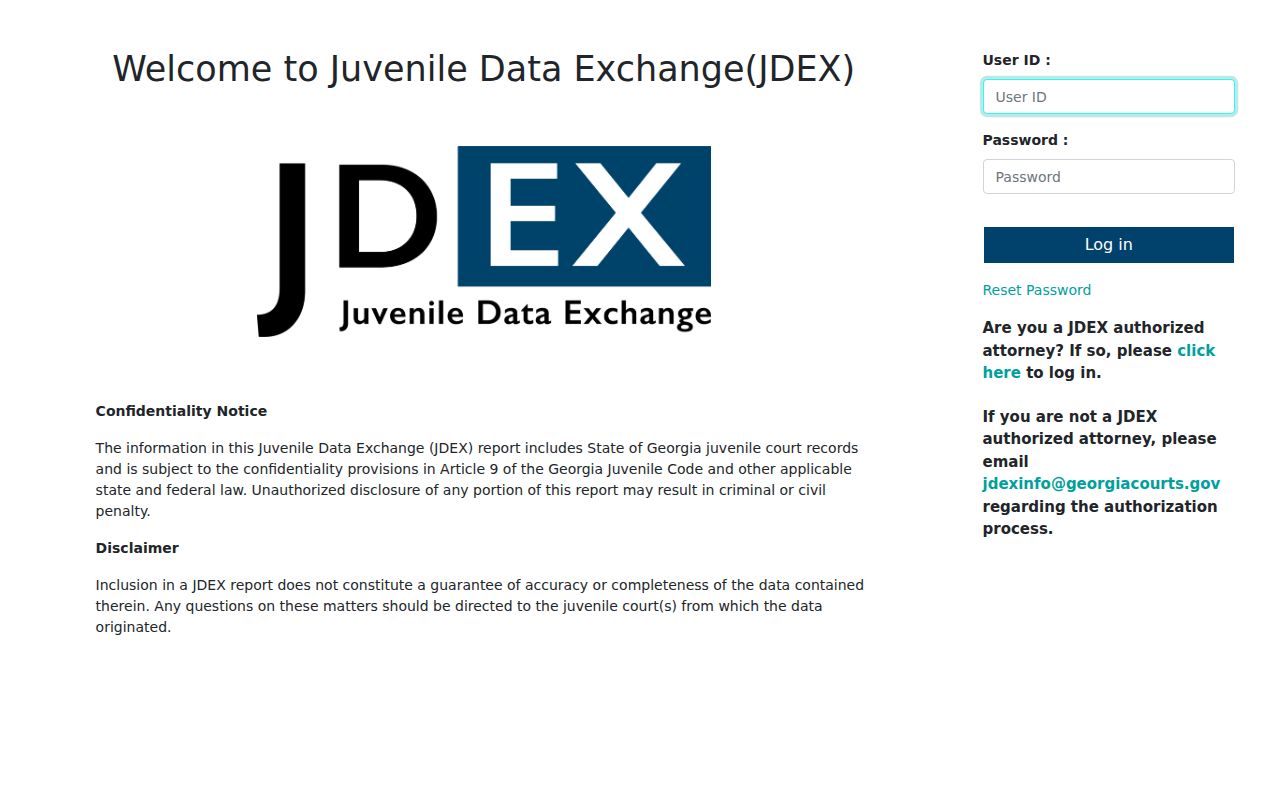
A login notice alone does not show that a public criminal docket runs through the same system.
Dawson County Criminal Appeals
A lower-court disposition can stay visible while an appeal is still moving. Rule 39.3 covers notice of appeal, transcript, remittitur, and cross-references to minutes or the final record. "Remittitur" marks an appellate mandate returning the case, or its effect, to the lower court. It does not erase every lower-court entry. Most Georgia state appeals land at the Court of Appeals of Georgia. The Supreme Court of Georgia takes its assigned constitutional, death-penalty, election, habeas, and other matters. When status matters, a criminal docket search should read both the lower-court appeal entry and the appellate record. A certified lower-court copy comes from the Clerk of Superior and Juvenile Courts. Appellate dockets and opinions come from the appellate court. The custodians differ even when the case number is related.
Dawson County Criminal Search Gaps
A blank result on a Dawson County criminal docket search does not clear anyone. The case may sit in the wrong court selection. Or it may not be scanned yet. Some older records sit behind a login. Juvenile and sealed files stay off public view. The entry could also rest with a different office. Or the name you typed belongs to another Dawson court, or to a different county altogether.
When the online docket search comes up empty, work the offline routes. Call the Superior and Juvenile Clerk at 706-344-3510. Show up at the records counter during posted office hours. You can also mail a written request that names the court, the case number, the date range, and the documents you want. Ask if a public terminal or an electronic copy exists. Magistrate records take a different path. Written Open Records requests go to the Chief Clerk directly.
Keep your request tied to the official court docket, not to judgments about a person. A pending charge, an arrest, an accusation, an indictment, a plea, a dismissal, and a conviction are separate events. Read what the record actually says before drawing any conclusion.