
How to Search Civil Dockets
Begin with the paper in front of you. Read the caption, the court name, the case number, and the filing date. Superior Court is the usual home for divorce, equity, and land-title matters, along with declaratory-judgment, mandamus, habeas, custody, adoption, contract, and premises-liability cases. Magistrate Court takes civil money claims up to $15,000. It also handles dispossessory cases, garnishments, liens, and abandoned-motor-vehicle matters.
For online work, the Georgia Courts E-Access directory routes Dawson Superior to PeachCourt. PeachCourt requires an account with the provider. The legacy Clerk case route offers no public search form. If the internet fails you, call the named clerk. Visit the correct counter, ask about a public terminal, or send a written request that names the court and the range of documents you need.
- Confirm Superior or Magistrate Court from the pleading, notice, or case caption.
- Use the action number exactly as printed, or gather party names and an approximate filing date.
- Check PeachCourt for the court and record type within its scope.
- Ask the clerk whether the docket is public, scanned, sealed, or held in paper form.
- Request a plain, file-stamped, or certified copy from the office that keeps the action.
Remember that a search result is only an index. Pulling the complaint, answer, motion, exhibit, or order itself may take a separate document request to the clerk.
Dawson County Civil Access
Georgia Courts lists Dawson Superior e-filing as PeachCourt mandatory. The provider works well for a civil index or a file-stamped document. But it requires an account. And it does not promise that every historical or restricted attachment will be visible. E-filing also leaves records in separate silos. Superior, Magistrate, Probate, Juvenile, and city files never merge into one search.
The county's own Superior Court page and Clerk page identify the local offices. A Magistrate civil record goes through the Magistrate Court route and its Chief Clerk. City ordinance records go to the Dawsonville City Clerk. A written request should name the custodian, the action number, the date range, the document types, the format you want, and whether you need certification.
If neither the provider nor the legacy portal answers, other options remain. The courthouse counter, phone, fax, and the written Open Records channel still stand behind the civil access chain. Ask whether inspection and copies carry separate charges.
What a Civil Docket Shows
Uniform Superior Court Rule 39.2 governs the civil docket. The index runs by party names and action number. Entries can include the case style, parties, attorneys, filing date, advance cost, complaint, and answer. They may also show motions, domestic-relations activity, URESA matters, contempt, modifications, judgment, and appeal references. The public page may expose only an event list. The full paper behind each line stays with the clerk.
| Action number | Unique identifier for the civil matter. The local Dawson format was not exposed, so use the court-issued number. |
|---|---|
| Caption and parties | Case style, plaintiff, defendant, other parties, and attorneys shown in the public index. |
| Filing and service | Complaint, answer, return of service, motion, notice, and file-stamped date when recorded. |
| Settings | Judge, hearing type, calendar date, time, courtroom or remote status, and later reset or continuance. |
| Orders and judgment | Rulings, judgment, satisfaction, dismissal, or other disposition entry with its date. |
| Appeal and cost | Advance cost, assessed fees, notice of appeal, record transmission, and remittitur where shown. |
The Georgia docketing rules set out the schema. They do not oblige the online provider to display every exhibit or confidential page.
Dawson County Civil Terms
Civil docket language runs terse. A complaint starts a claim. An answer responds. A return of service records how notice reached the other side, a motion asks the court to act, and a judgment resolves an issue or the whole case. A satisfaction shows the judgment was paid or otherwise resolved. A "setting," meanwhile, is just a scheduled event, not proof of any ruling.
- Caption or style
- The court's case title, normally the parties and county or court information.
- Return of service
- Proof that a summons, complaint, or other process was delivered as required.
- Advance cost
- Civil filing money deposited or assessed when an action begins under the docket rules.
- Dispossessory
- A Magistrate proceeding involving possession of property under the court's dispossessory process.
- Garnishment
- A proceeding directed at a garnishee under a claim or judgment.
- Lis pendens
- Notice that litigation may affect title or an interest in real property.
For the legal effect of a ruling, read the order or judgment itself. A short docket line names the filing without stating the full relief requested or granted.
Types of Civil Cases on the Docket
Superior Court gives Dawson County its broad civil route. Its court records can hold family and domestic-relations matters, land-title disputes, equity, contracts, premises liability, custody, adoption, habeas, mandamus, and appeals from limited courts. Magistrate Court plays a narrower role. Its docket can still live a long time, though, with answer, service, judgment, garnishment, exemption, and satisfaction entries.
| Case type | Likely court | Record clue |
|---|---|---|
| Divorce, custody, equity, or land title | Superior Court | Domestic-relations order, complaint, motion, or title-related entry |
| Contract or premises liability | Superior Court | Complaint, answer, service, discovery, motion, or judgment |
| Money claim up to $15,000 | Magistrate Court | Statement of claim, answer, service, judgment, or satisfaction |
| Dispossessory | Magistrate Court | Affidavit, answer, service, hearing, and possession result |
| Garnishment or abandoned vehicle | Magistrate Court | Affidavit, answer, exemption claim, lien, or foreclosure motion |
The Dawson Magistrate page gives the local jurisdiction and the filing route. A record that starts in Magistrate can gather post-judgment entries over the years. It never turns into a Superior action just because both offices share the county courthouse.
Dawson County Civil Jurisdiction
Superior and Magistrate civil dockets answer different questions. Superior Court holds general civil jurisdiction. It hears matters like divorce, equity, land title, and contract disputes. Magistrate Court caps civil money claims at $15,000 and runs no jury trials. Jurisdiction shapes the form you file and the clerk you visit. It also shapes the fee schedule and the path for later filings.
The Georgia court guide supplies the state-level framework. Local Magistrate pages add Dawson-specific filing and service instructions. Where a case has a related Superior action, keep the action numbers separate. Ask the clerk about a companion or cross-reference instead of assuming one docket holds both.
So begin a civil search with the caption and court, not just a party name. That habit prevents mix-ups. It keeps a Magistrate dispossessory record from being mistaken for a Superior domestic-relations or property case.
Dawson County PeachCourt Filing
Filing in Dawson Magistrate now runs through PeachCourt. A filer opens or uses an account. The filer picks Dawson County Magistrate Court, uploads PDF documents, lists each party individually, and pays the required fees online. The platform usually auto-serves the filing. The filer still must confirm service and arrange anything extra. A paper exception exists for a person legally or practically unable to e-file, such as someone incarcerated, indigent, or simply without internet access.
Under the Magistrate policies, motions should generally be filed at least 48 hours before a hearing, or the court may not consider them. That clock matters. It makes the filing date, the service date, and the hearing date three separate docket facts.
The county's policy page lays out how e-filing, service, and hearing timing connect in a Dawson County civil docket. Timing drives every docket entry.
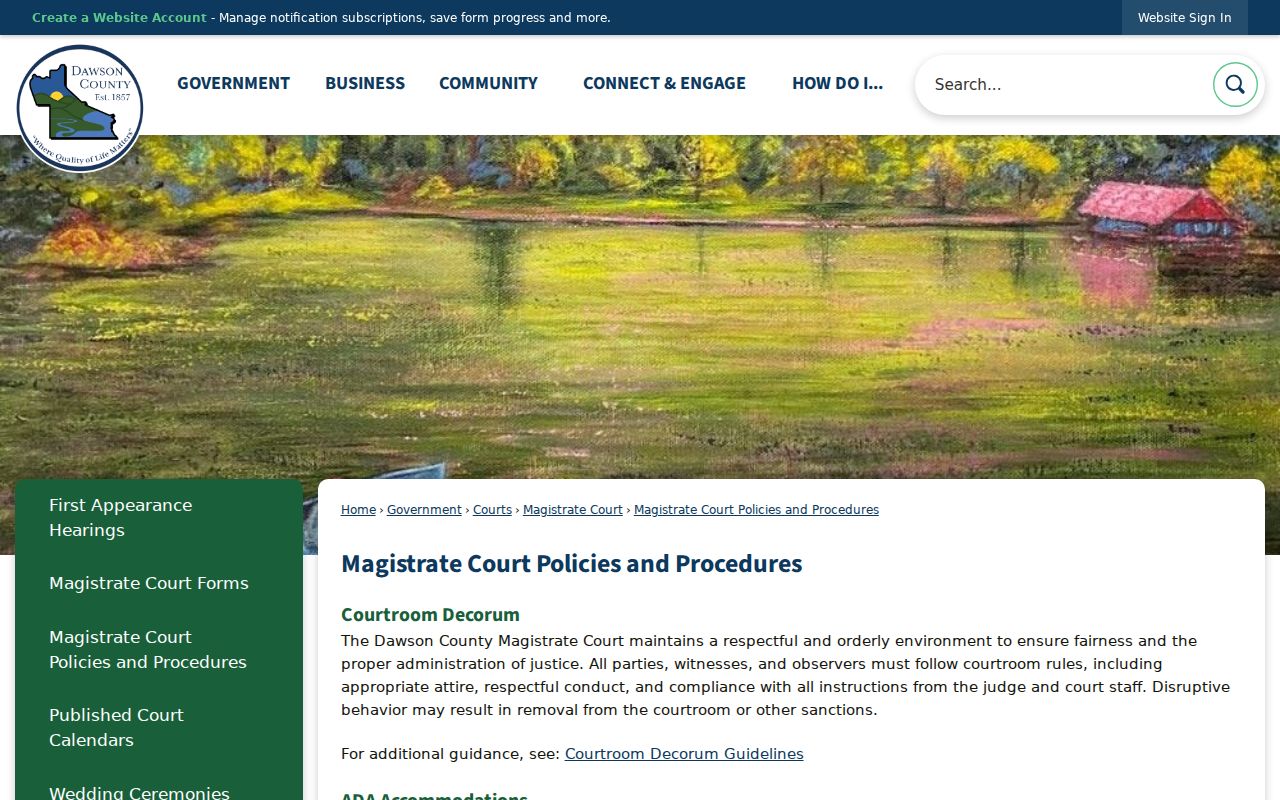
Treat the policy as a workflow reference. Then verify the current form, fee, and deadline with the Magistrate Court itself. PeachCourt access is not a guaranteed public download. The clerk can say whether a filed document is available and whether a plain or certified copy needs its own request.
Dawson County Magistrate Forms
The Magistrate form catalog walks a limited civil case from start to finish. The General Statement of Claim opens it. A General Civil Answer and a Certificate of Service come next. Beyond those sit Continuance Requests, Dismissals of Claim, and Satisfactions of Judgment, along with dispossessory and garnishment affidavits and answers, exemption claims, traverses, post-judgment interrogatories, and abandoned-motor-vehicle pleadings.
Access forms share the catalog. Those cover interpreter requests, ADA accommodation, remote appearance, change of address, and opt-out from electronic service. One caution applies. A form title is not a ruling. A blank PDF is not a filed case document. Before relying on any form, confirm its current version, signature block, service method, and processing requirement.
The county's catalog groups forms by the civil docket event each one creates. Each group matches a different docket step.
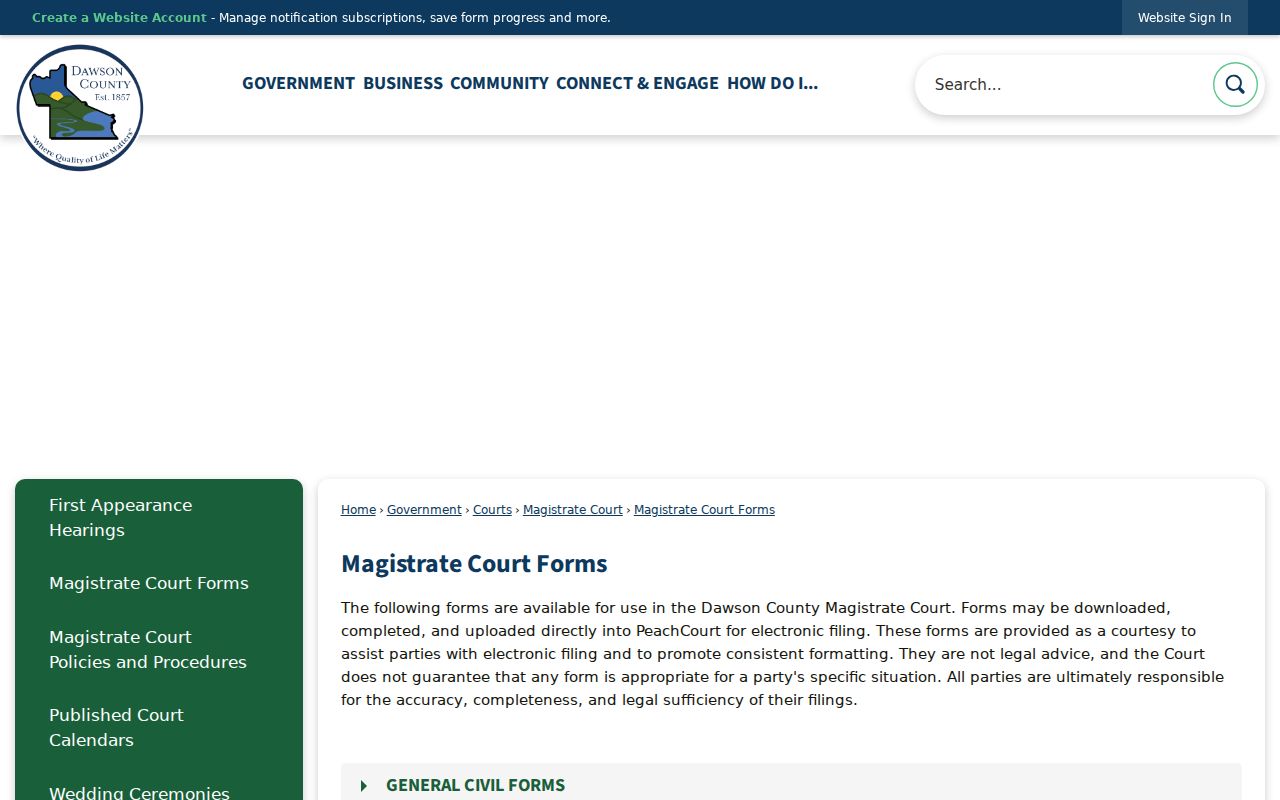
That life-cycle view links a form to the docket entry it later becomes. The catalog itself is not a case search, though.
Settings and Hearings on Civil Dockets
A civil docket entry can carry a hearing, trial, motion calendar, status conference, or case-management setting. Each detail answers a different question. The date, time, judge, and courtroom or remote status each do separate work. So do the filing date and service date. A continuance or reset moves the calendar only. It does not dismiss a claim or grant the motion. Read the later order or judgment for the result.
The Dawson County court calendar page explains why there is no general online date lookup. It also explains why settings must be confirmed through the correct office or counsel. Dawson's remote-hearing examples come from the Northeastern Judicial Circuit. A specific civil case still follows its notice and judge procedure. One timing wrinkle deserves a question. A motion may arrive less than 48 hours before a Magistrate hearing. Then ask whether the published policy affects consideration. The docket may record filing and setting dates without explaining the response.
Dawson County Civil Volume
The official Dawson County 2025 Budget Guide counts civil cases opened at 555 in FY2021, 494 in FY2022, and 523 in FY2023. Closures ran 512, 519, and 550. These are Clerk department measures. They are not a live count of pending actions. They measure neither parties nor the strength of any claim.
FY2025 targets were 750 civil openings and 650 civil closures. A closure can span years. It may cover an action opened in an earlier year. The figures cannot say whether a case remains active. The budget guide is the source for the reported measures.
Dawson County Civil Fees
Fees vary by court and change over time. Dawson Magistrate takes cash, law-firm checks, cashier's checks, and Visa or MasterCard with a 4 percent processing fee. Personal checks are not accepted. The current amounts sit in the linked Magistrate fee schedule, and older figures on the legacy Superior site are not verified rates.
| Item | Published detail |
|---|---|
| Magistrate card payment | Visa or MasterCard accepted with a 4 percent processing fee |
| Magistrate personal check | Not accepted |
| Magistrate filing or service amount | Use the current official fee schedule; do not rely on old legacy figures |
| Plain or certified copy | Ask the holding clerk for the current copy and certification charge |
Separate the pieces. A request should list filing fees, service charges, copy charges, certification, and vendor access, and ask for an estimate before a large document request is processed.
Public Access to Civil Dockets
Georgia does not open every civil page. Superior Court Rule 21 governs limits on Superior files. Rule 36.17 covers sensitive identifiers. Rule 39 describes the civil docket. Juvenile, adoption, protected-identifier, sealed, and confidential pages may be withheld or redacted. A docket can remain visible anyway, even when an attachment is not.
Request in plain terms: Identify the court, action number, date range, document type, desired format, and whether a certified copy is needed. Under the Georgia Open Records Act guidance, a custodian should explain timing, estimated cost, or the legal basis for withholding a responsive record.
Magistrate records take a separate written request to the Chief Clerk. Superior files belong with the Clerk of Superior and Juvenile Courts. City matters go to the Dawsonville City Clerk. Not every mentioning office holds the record.
Dawson County Civil Requests
A written request for Dawson County civil docket material works best when it is specific. Name the case number or the date range you want, and say whether you want to inspect the docket or get copies of filed documents. Ask for electronic copies if the office can provide them. Request an estimate up front for search, retrieval, copy, certification, or vendor charges, and ask that any redaction or exemption be identified by legal authority.
Georgia's Attorney General says a public-record request can be oral or written. Expect a response within three business days unless an exception applies. When production will take longer, the custodian should give you a production estimate and cost information. Keep in mind the request does not require the office to create a new compilation, though an existing electronic printout may be available when no significant programming is needed.
Transcripts are different. For one of those, contact the court reporter or follow the process the court describes. A transcript is not automatically a Clerk-created document just because the docket lists it.